Reduced to Rubble: Decay and neglect destroy Las Vegas’ history
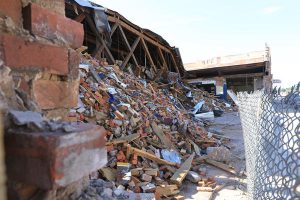 Las Vegas lost another piece of history recently when a brick building on Grand Avenue crumbled onto the sidewalk below.
According to Virginia Marrujo, the interim community development director for the City of Las Vegas, the building near the intersection of Grand and Douglas Avenues once belonged to the Maloof family. She said code enforcement officers, police, firefighters and workers with the Environment Department responded soon after the initial collapse.
“We contacted the owner,” Marrujo said. “The owner said it was OK to do what we had to do. At that point, (crews) knocked down all the front bricks that were falling.”
It is not a unique case though. All over the Meadow City, buildings sit vacant, slowly decaying and crumbling. It’s a problem Marrujo wants to solve.
“We need to save these buildings, so we’re going to do everything we can,” she said.
To aid in that mission, the city’s community development department has recently hired two new code enforcement officers. Marrujo admits that she and her staff are new to code enforcement, but she said they are learning the job.
“We attend whatever trainings come up throughout the state, so we get an idea of every community and what they’re doing,” she said.
Marrujo and her team are planning to meet with the New Mexico Historic Preservation Division and the Construction Industries Division to assess crumbling buildings across the city, and to see what can be done to save them.
They face many obstacles though. One of the biggest, Marrujo said, is the city’s current code enforcement ordinances, which she called outdated. Under the current codes, the city can cite property owners for neglecting their buildings or allowing them to become a nuisance to the community, but Marrujo said the fines are small, with most ranging between $50 and $100.
“Because the fines are minimal, the way I see it, people are willing to pay the fines, which is cheaper than having to fix a building,” she said. “So we’re trying to look at a way to fix our ordinances so they’re updated and cause people to want to fix their buildings.”
While many buildings have fallen victim to neglect, a few have been given new life by private owners and investors, like Allan Affeldt, who has restored well-known historic buildings like the Plaza Hotel and the Castañeda Hotel.
Affeldt said that in his five years in Vegas, and 15 years of visiting regularly, he hasn’t seen the city do much to address Las Vegas’ crumbling history.
“For the city to say, ‘We have to rewrite our ordinances’ while the beautiful city hall on Sixth Street is literally falling down, is ridiculous,” Affeldt said. “They don’t need to rewrite an ordinance to repair that building.”
Affeldt does agree that city ordinances need to be updated, though.
“The city needs to rewrite its whole code book, and its charter,” he said. “We’re paralyzed because of problems in the charter. Those things can be fixed, but it’s going to take serious effort … and that’s not going to happen under the current administration.”
Another obstacle stems from property owners who believe their buildings are worth more than the true market value. Both Marrujo and Affeldt agree it’s a problem.
“That’s another issue we have,” Marrujo said. “They want to sell for these outrageous prices, but the amount of money that goes into fixing these historic buildings … makes it hard. People don’t want to pay an outrageous (amount) and then have to pay double that to fix the building.”
Affeldt points out that in order for a buyer to get a loan, the building’s owner cannot ask for more than its worth.
“What they don’t seem to understand is that you have to have an appraisal to get a loan, so you can’t ask more than it’s worth and expect it to be sold,” he said. “You have to sell it for what it’s actually worth, and you have to have an appraisal.”
While a buyer paying in cash could, in theory, pay more than a building’s appraised price, it’s something Affeldt thinks is unlikely.
“Who’s going to come along and write an $800,000 check for the parachute factory, which is going to take $2 million to restore? Nobody.”
The result affects all of Las Vegas, Affeldt said, because while property owners continue to seek high prices for their buildings, those buildings continue to deteriorate.
“What happens when these buildings start to fall down is that we lose our sense of place, and we lose our attractiveness — not only to ourselves, but to the bigger world,” he said. “What’s happened in Las Vegas is that the money that built all these fabulous buildings isn’t there anymore, which means people own these old buildings, but they don’t fix them up. The inevitable result of that is what happened on Grand Avenue.”


